
日本語は英語の後に記載してあります。
The 2024 Noto Peninsula earthquake, with a magnitude of 7.6, has been a topic of significant academic study. It involved complex fault mechanics influenced by deep-seated crustal activity and fluid migration. This earthquake occurred along known offshore active faults, such as the Suzu and Wajima segments, but researchers are still analyzing whether parallel faults also played a role in triggering the event
Earthquake Mechanism
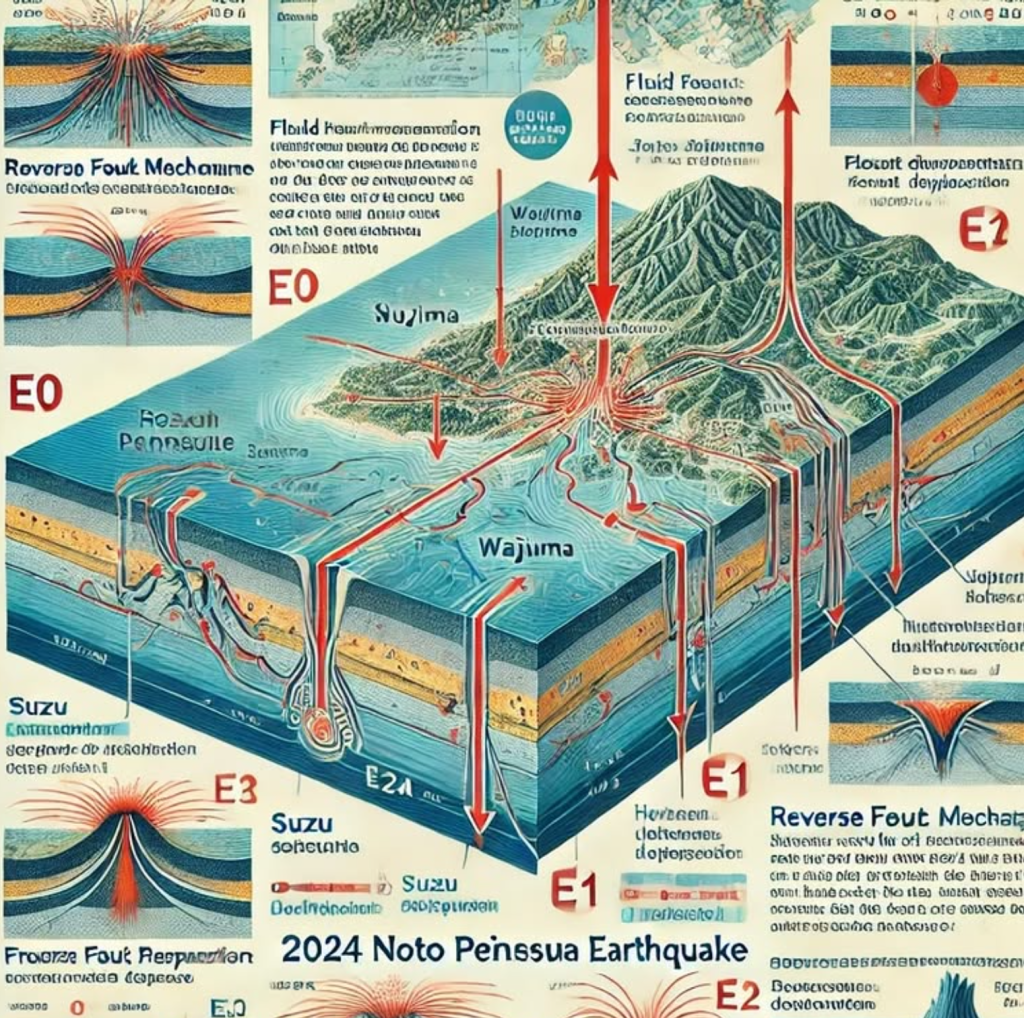
The earthquake was characterized by reverse faulting with multiple rupture events. Initially, a slow rupture (E0) propagated westward for about 10 seconds before activating larger faults (E1 and E2), spanning a 65 km area. Simultaneously, fault slippage occurred on the eastern side (E3), demonstrating a unique rotation in the fault’s orientation . This multi-phase rupture development contributed to the significant impact, making the earthquake difficult to predict based on standard fault behavior models.
Role of Fluid Migration
Ongoing seismic swarms since 2020 in the region indicated the involvement of fluids rising from deep underground. These fluids may have infiltrated fault zones, weakening them and making the area prone to larger seismic events. The earthquake’s rupture was also facilitated by stress accumulated along these fault lines over time, enhancing the chance of fault movement .
Impact and Research Insights
This earthquake marked the first instance of a seismic intensity of 7 being recorded in the Noto region, with widespread ground deformation and liquefaction reported. Research presented at the Earthquake Engineering Conference highlighted severe impacts on infrastructure, including bridges and ports, and emphasized the importance of UAVs and LiDAR in post-earthquake damage assessments  .
The findings from this earthquake underscore the need for advanced seismic risk evaluation, particularly in regions with active faults influenced by deep crustal processes and fluid dynamics.
2024年能登半島地震
2024年の能登半島地震(マグニチュード7.6)は、学術的な研究対象として大きな注目を集めています。この地震は、深部地殻活動や流体移動の影響を受けた複雑な断層メカニズムが関与していました。この地震は、珠洲断層や輪島断層といった既知の沖合活断層に沿って発生しましたが、並行する断層も地震発生の引き金となったかどうか、研究者による分析が続いています。
地震メカニズム
この地震は、複数の破壊イベントを伴う逆断層運動が特徴的でした。初期段階では、ゆっくりとした破壊(E0)が西方向へ約10秒間伝播し、その後、より大きな断層(E1およびE2)が作動し、約65kmの範囲にわたる破壊を引き起こしました。同時に、東側の断層(E3)でも断層滑りが発生し、断層方向に独特の回転が見られました。この多段階破壊の進展が影響を大きくし、通常の断層挙動モデルに基づく予測を困難にしました。
流体移動の役割
2020年以降、この地域で続いている群発地震は、地下深部から上昇してくる流体が関与していることを示唆しています。これらの流体は断層帯に浸透し、断層を弱めることで、より大規模な地震を引き起こしやすい状態を作り出した可能性があります。また、この地震の破壊は、時間とともにこれらの断層線に沿って蓄積された応力によっても促進されました。
影響と研究の洞察
この地震は、能登地域で初めて震度7が観測された事例であり、広範囲にわたる地盤変形や液状化が報告されました。地震工学会議で発表された研究では、橋梁や港湾などのインフラに深刻な影響が及んだことが強調され、地震後の被害評価におけるUAV(無人航空機)やLiDARの重要性が指摘されました。
結論
この地震から得られた知見は、深部地殻プロセスや流体動態の影響を受ける活断層を有する地域において、高度な地震リスク評価の必要性を強く示しています。